
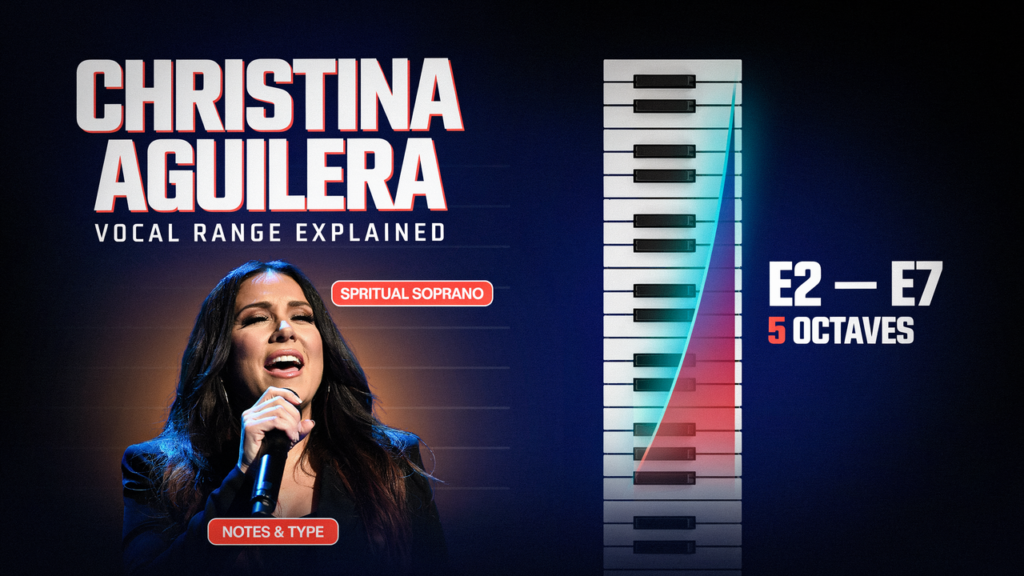
Christina Aguilera’s commonly reported vocal range extends approximately from C3 to C♯7, covering four octaves and one semitone when her whistle register is included. The C♯7 is associated with “The Christmas Song,” while the exact C3 lower boundary is less consistently documented across public analyses.
That total span does not mean Aguilera belts across four octaves. Her recorded range combines low modal notes, a powerful chest-dominant middle register, mixed and head-voice singing, and occasional whistle tones. Her practical musical range is narrower but more consistently demonstrated.
What Is Christina Aguilera’s Vocal Range?
A cautious full-range estimate for Christina Aguilera is C3–C♯7. The distance between those pitches is 49 semitones, equal to four octaves and one semitone.
Some sources simply describe her as a four-octave singer without naming exact endpoints. That is a reasonable summary because the C3 low and C♯7 whistle note use very different types of vocal production.
| Vocal area | Approximate context | Evidence interpretation |
|---|---|---|
| Around C3 | Lowest reported modal extension | Reported, but exact song evidence varies |
| D3–E3 | Low notes found throughout her ballads | Reliably represented in published material |
| Fourth octave | Main chest and middle register | Central to her singing |
| Fifth octave | Belts, mixed voice, head voice, and riffs | Strongly demonstrated |
| E6 | Upper-register pitch in “What a Girl Wants” | Supported by published song-range descriptions |
| C♯7 | Whistle pitch associated with “The Christmas Song” | Commonly documented upper extreme |
The range should therefore be understood as a map of everything she has demonstrated—not the area in which every note has equal power, comfort, or usefulness.
What Is Christina Aguilera’s Lowest Note?
C3 is frequently cited as Christina Aguilera’s lowest recorded pitch. However, this endpoint is not as consistently connected to one clearly documented song as several of her higher notes.
More firmly supported examples appear slightly above it. “The Voice Within” extends down to D3, while “Beautiful” reaches E3. “You Lost Me” begins its reported range at E♭3. These songs confirm that Aguilera has a developed lower register rather than simply touching one isolated low note.
Her low notes have an unusually grounded quality for a singer famous for high belts and whistle tones. She can use a dark, smoky color before increasing brightness and vocal intensity as a phrase rises.
That low-end presence creates a useful connection with Gladys Knight’s vocal range. Aguilera has cited and reflected the influence of soul singers whose authority comes from phrasing, tone, and emotional weight—not only upper-register power.
What Is Christina Aguilera’s Highest Note?
C♯7 is commonly identified as Christina Aguilera’s highest recorded pitch. It is associated with “The Christmas Song” from My Kind of Christmas and is produced in whistle register.
C♯7 is extremely high, sitting more than an octave above soprano C6. It should not be described as a chest-voice belt or as part of Aguilera’s normal tessitura.
Her whistle register appears selectively rather than functioning as the foundation of her singing style. This distinguishes her from singers whose public identity is more closely associated with frequent whistle-register melodies.
Aguilera’s most musically significant high singing generally occurs lower, particularly through the fifth octave. There she can belt, mix, sustain phrases, articulate lyrics, and execute melismatic runs with greater tonal weight.
A comparison with Patti LaBelle’s vocal range helps illustrate the difference between an extreme whistle pitch and dramatically projected upper-register singing. Both are impressive, but they represent different vocal skills.
Does Christina Aguilera Have a Four-Octave Range?
Yes. If the commonly reported C3–C♯7 endpoints are accepted, Christina Aguilera has demonstrated slightly more than four octaves.
The exact calculation is:
- C3 to C4: one octave
- C4 to C5: a second octave
- C5 to C6: a third octave
- C6 to C7: a fourth octave
- C7 to C♯7: one additional semitone
The result is four octaves and one semitone. It would be inaccurate, however, to interpret this as four octaves of equally usable full voice.
Her total range includes multiple registers, and its extreme ends appear far less frequently than her central working range. A four-octave measurement tells us how far apart her documented endpoints are; it does not reveal her comfortable tessitura by itself.
Christina Aguilera’s Whistle Register
Whistle register is the highest vocal production associated with Aguilera’s range. It creates a small, flute-like sound above the normal head-voice region and can produce pitches in the sixth or seventh octave.
Not every very high Aguilera note is whistle register. Her upper singing may include:
- Chest-dominant belts
- Mixed coordination
- Head voice
- Falsetto-like or flutelike sounds
- Whistle tones
The register label should be based on the sound and context, not pitch alone. A sixth-octave note may be produced in head voice, while a higher and thinner tone may be better categorized as whistle.
Aguilera uses whistle as an additional color rather than the primary measure of her artistry. Her control of chest, mix, and head voice across complete songs is more representative of her career.
How High Can Christina Aguilera Belt?
Christina Aguilera’s recognizable belts frequently extend through the fifth octave, but exact upper limits vary according to the definition of a belt and the performance being analyzed.
“What a Girl Wants” has a published song range reaching E6, yet that does not mean every pitch up to E6 is produced as a heavy chest-dominant belt. Its uppermost notes may involve lighter coordination, ornamentation, or layered studio vocals.
“Beautiful” spans approximately E3–G5 and includes numerous melismatic passages. “The Voice Within” reaches F♯5, while “Dirrty” has a reported upper note of F♯5. These songs provide clearer evidence of her sustained and musically integrated fifth-octave singing.
Aguilera’s belts often sound large because of their tonal edge, vowel shape, and controlled distortion. Perceived power does not necessarily mean she is pulling pure chest voice upward. Effective contemporary belting normally involves changing resonance and vocal-fold coordination as pitch rises.
Aretha Franklin’s vocal range provides a meaningful stylistic comparison. Aguilera’s use of melisma, gospel-influenced intensity, and vocal dynamics reflects a tradition in which the high note serves the emotional phrase rather than existing only as a range demonstration.
Is Christina Aguilera a Soprano or Mezzo-Soprano?
Christina Aguilera is most often described as a soprano, but her voice also possesses a substantial lower register and a heavier chest-dominant color that some listeners associate with mezzo-soprano singing.
A careful description is that she is a soprano-oriented contemporary vocalist with strong lower extension, considerable vocal weight, and access to whistle register.
Her C♯7 does not prove that she is a soprano, just as her C3 does not make her a contralto. Voice classification also considers:
- Tessitura
- Timbre
- Vocal weight
- Passaggio locations
- Register balance
- Sustainable repertoire
Contemporary pop singers use microphones, stylistic distortion, altered vowels, and studio production, so classical labels cannot always describe them precisely.
Comparing Aguilera with Lady Gaga’s vocal range demonstrates this issue. Both have strong voices with broad stylistic capabilities, yet their comfortable placement and tonal behavior matter more than whether their highest notes overlap.
Melisma, Rasp and Dynamic Control
Aguilera is strongly associated with melisma—the performance of several pitches on one syllable. Her riffs may change direction rapidly, cross register areas, and use deliberate rhythmic variations.
Melisma can make a performance sound spontaneous, but successful runs require precise pitch organization. Speed alone is not enough; each note must remain connected to the musical phrase.
Her rasp is another important part of her sound. Aguilera may add a rough surface to an otherwise pitched note, especially during emotional peaks. This is distinct from an unpitched scream, although the boundary can become difficult to judge in highly aggressive moments.
Her approach can be contrasted with Brandy’s vocal range. Brandy is known for intricate layering and unusually controlled harmonic detail, while Aguilera often places her technical display at the front of the performance through powerful belts and exposed runs.
Songs That Best Demonstrate Her Voice
“Beautiful” shows more than two octaves of range, moving from intimate phrases to resonant fifth-octave climaxes. It also demonstrates her melisma and dynamic contrast.
“The Voice Within” spans approximately D3–F♯5. Its gradual modulation and increasingly forceful ending reveal her ability to build vocal intensity.
“What a Girl Wants” contains an upper extension reported as high as E6. The song highlights the agility and bright tone of her early career.
“The Christmas Song” contains the whistle-register pitch most frequently identified as C♯7.
“You Lost Me” emphasizes control and emotional restraint before expanding into a dramatic climax. Its approximately E♭3–E5 span is narrower than her full range but highly expressive.
“Ain’t No Other Man” relies on rhythmic accuracy, brassy tone, and energetic phrasing rather than her most extreme notes.
How Her Voice Has Changed
Aguilera’s early recordings emphasized youthful brightness, high embellishments, and upper-register agility. Later material introduced more lower-register weight, rasp, blues influence, and deliberate tonal contrast.
Live arrangements may also change key or phrasing over time. A singer can modify climactic notes to suit the performance schedule, stylistic goal, or current vocal condition without losing their fundamental ability.
Listeners mapping their own voice can use the vocal scale finder to connect comfortable notes with practical scales. The goal should be repeatable control, not copying Aguilera’s C♯7 or forcing her heaviest belts.
Frequently Asked Questions
What is Christina Aguilera’s vocal range?
Her commonly reported full range is approximately C3–C♯7, covering four octaves and one semitone when whistle register is included.
What is Christina Aguilera’s highest note?
C♯7 is commonly cited as her highest recorded pitch and is associated with “The Christmas Song.” It is a whistle-register note, not a belt.
Can Christina Aguilera sing four octaves in full voice?
No evidence shows four continuous octaves of full or chest voice. The total combines low modal singing, belts, mixed and head voice, and whistle register.
Is Christina Aguilera a soprano?
She is commonly classified as a soprano in contemporary descriptions. Her lower extension and vocal weight add mezzo-like color, but exact classification cannot be determined from endpoints alone.
Which song best demonstrates Christina Aguilera’s range?
No single song covers her entire reported range. “Beautiful,” “The Voice Within,” “What a Girl Wants,” and “The Christmas Song” collectively demonstrate different areas and registers.

Harlow is a vocal analysis and singing tools writer at Voice Range Test. She focuses on vocal range testing, voice type analysis, pitch recognition, and singing education tools for singers, musicians, choir performers, and beginners.